
Call us:+31 - (0) 184 651 451
Choosing a used marine diesel engine is rarely a straightforward decision. Buyers need to balance technical compatibility, availability, delivery times and budget while keeping vessel downtime to a minimum. This guide explains what to consider before buying a used marine engine.
Before comparing used marine diesel engines, make a list of the technical requirements the engine must meet. This gives you clear criteria for assessing available units and helps identify any gaps early.
Start with these points:
Application and duty: Will the engine provide main propulsion or serve an auxiliary role? How will the vessel typically operate, and under what load?
Power and rated speed: What power and engine speed does the application require? Consider these together; matching the power figure alone does not establish suitability.
Engine configuration: Does the engine have the marine configuration required for the application? Confirm details such as its cooling and exhaust systems for the specific unit.
Propulsion system: Check compatibility with the gearbox, reduction ratio and propeller. If replacing an existing engine, record the details of the current setup.
Installation: Confirm the available space, engine mounts, connection points and access for maintenance. Check what would need to change to install the candidate engine.
Documentation and approvals: Identify any class, flag state or emissions requirements before selecting an engine. Confirm that the specific unit has the documentation your project requires.
Use the existing engine’s nameplate, technical documents, installation drawings and measurements as a starting point. If you do not have an existing engine to reference, we are happy to help you.
Power and speed are key selection criteria, but they need to fit the engine’s application and the vessel’s propulsion system. Confirm these requirements before comparing price or availability.
A new engine may offer a configuration selected for a particular project, subject to the manufacturer’s available options and delivery schedule. A used engine is an existing unit with a specific history, configuration and condition. It may be available sooner if a suitable unit is in stock, but it may require adaptation to fit the vessel.
The purchase price is only one part of the comparison. Include installation, transport, necessary modifications, servicing and any components that are not supplied with the engine. Compare the total project cost and timing, not just the engine prices.
A used engine may be worth considering when:
Its rated power and speed suit the vessel
Its dimensions and connections can be accommodated
Its condition and history are sufficiently clear
Required documentation and approvals are available
The full installation cost makes sense for the project
Each used engine has its own history. Operating hours can help describe its use, but hours alone do not establish its condition. Maintenance, operating conditions, storage and the way the engine was removed also matter.
Ask us for the information and inspection records which is available for the specific engine.
Request the recorded operating hours and ask how they were established. Review service records, maintenance invoices and any notes about repairs or periods out of service. If the history is incomplete, treat that as an uncertainty to resolve in your assessment.
Inspect the engine for visible leaks, corrosion, damaged connections, unusual wear and signs of previous repairs. Look at the condition of hoses, wiring and attached equipment, and confirm what is included in the sale.
Photographs are useful for an initial review. For a serious purchase, arrange an inspection or ask for clear images of the areas that matter to the installation.
Where access allows, an endoscope inspection of the cylinder liners can provide additional information about their visible condition. It is one part of an assessment; it does not replace a review of the engine’s history and other inspection findings.
Ask whether the engine has been test-run and what that test covered. Pool Trading states that its engines are systematically inspected and test-run. Request the inspection or condition report for the particular engine and ask what was observed during its test.
Confirm the engine make, model and serial number, and ask which documents are available. Depending on the vessel and project, relevant documents may include service records, test information, certification and technical files.
Also confirm exactly what is included: for example, the engine alone or specified attachments and accessories. Clarify any exclusions before comparing offers.
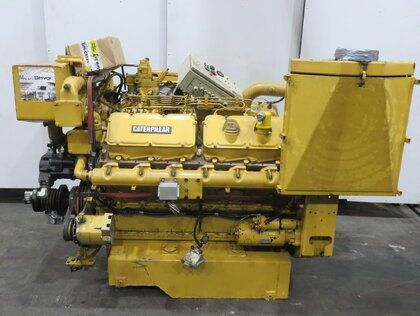
The used marine engine market includes manufacturers such as Caterpillar, Cummins, Detroit Diesel, Deutz, Scania and Volvo Penta. A familiar brand can make it easier to research technical documentation or locate service support, but the brand name alone does not show whether a particular engine is right for your vessel.
Compare the engine’s rating, speed, configuration, condition, documentation and fit with the installation. Check the availability of parts and service support for the model in the region where the vessel will operate.
Do not assume that an engine is suitable for marine use based only on its make or model name. Engines from the same manufacturer may have different configurations and ratings for different applications.
Pool Trading describes its second-hand marine engines as units previously used on vessels, most often for propulsion and sometimes for generator or auxiliary use. Many have water-cooled exhaust systems, but each engine’s setup reflects its former application and actual condition. Check the cooling and exhaust systems, rating and other application-specific details for the individual engine, and confirm that its configuration suits your vessel.
Two engines with similar power figures may differ in rated speed, dimensions and configuration. Check the full rating and how the engine will work with the gearbox and propeller.
Space, mounts, shaft alignment, exhaust routing and service access can affect the feasibility and cost of a replacement. Check them before committing to an engine.
A low purchase price may not reflect the total cost of getting the engine installed and ready for use. Include transport, modifications, missing parts, maintenance and commissioning in the comparison.
Hours are one data point. Consider them together with maintenance records, inspection results, storage history and test information.
At Pool Trading, we supply used diesel engines for maritime and industrial applications. We inspect and test-run each engine, and any necessary repairs or reconditioning can be carried out in our workshop.
Every engine has its own history and condition. We can share the available information about the specific unit and help you assess how it may fit your project. Our team can also provide technical and practical advice as you compare your requirements with available engines.
If you are looking for a used marine diesel engine, tell us about your vessel, required power and speed, installation and documentation requirements. Contact us and we will help you explore the available options.
Have one to sell? Get an offer from Pool Trading
